Situation
Single agent reinforcement learning has clean convergence guarantees. As soon as you put a second learning agent in the same environment those guarantees stop holding, and I wanted to see that happen rather than just know it.
Task
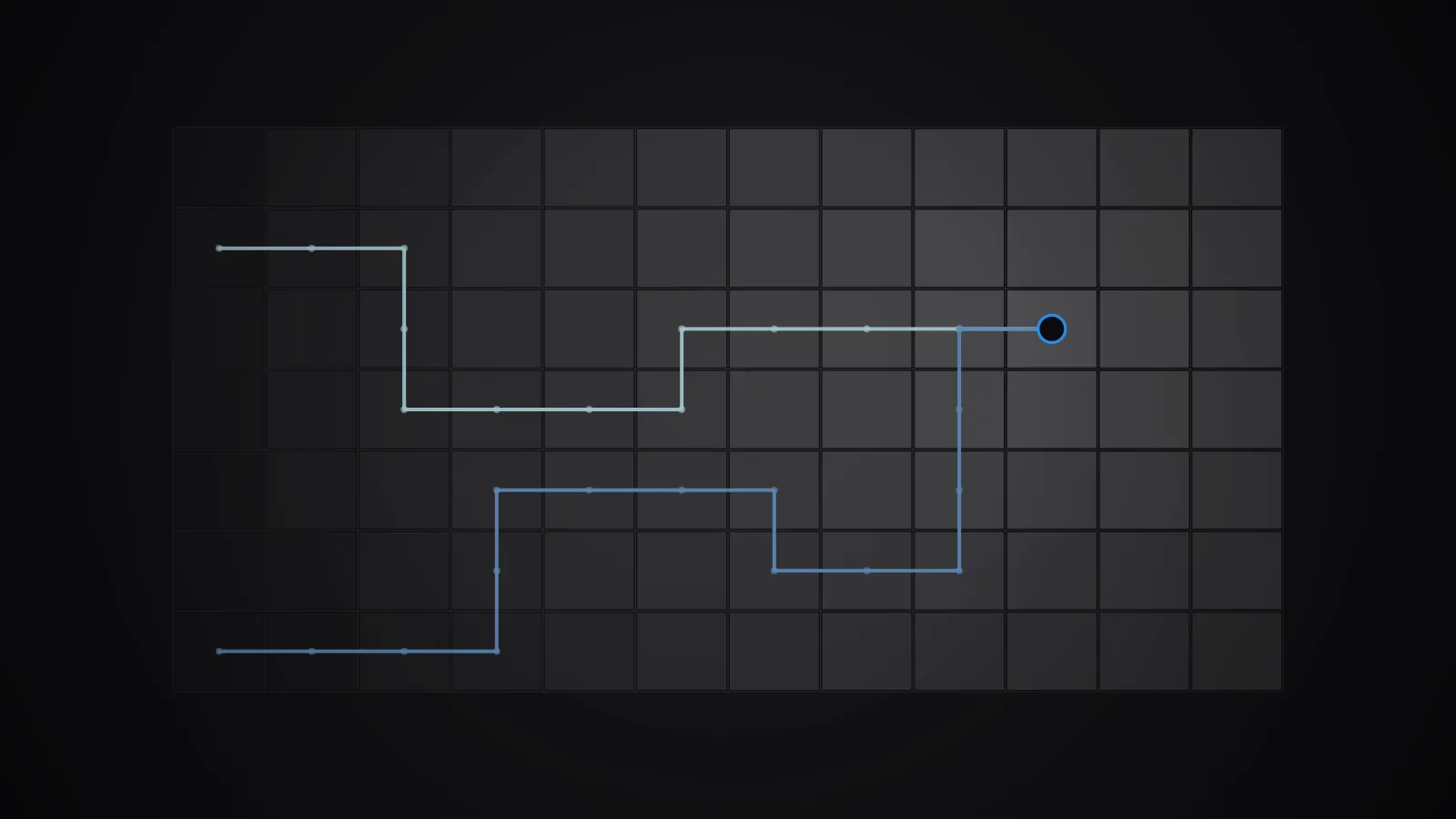
Implement tabular Q-learning for two agents that have to coordinate in a stochastic grid world, with no communication channel between them, and then actually analyse what the learned policies were doing.
Action
I implemented independent Q-learning, where each agent treats the other as part of the environment, with expected value Bellman updates over the stochastic transitions.
Then I analysed the result two ways. I used replicator dynamics from game theory to look at the learned policies as strategies rather than as tables of numbers, which shows you which equilibria the agents are being pulled towards. And I ran a structural experiment varying the step penalty across two asymmetric coordination phases, to see how much the reward shaping was doing versus the learning.
Result
It coordinates, and more usefully it fails in the way the theory says it should.
Q-learning’s convergence proof assumes a stationary environment. With two learners that assumption is broken, because each agent is chasing a target the other one keeps moving. That is a sentence I had read plenty of times. Seeing it as instability in my own learning curves, where both agents keep adjusting to each other and the values wobble instead of settling, is what actually made it mean something.
The step penalty experiment showed how much of the coordination was coming from the reward design rather than from the agents working anything out, which was a useful check on not overclaiming what the learning had achieved.